2 Jun 2026 · 5 min read
Do Compression Boots Actually Work? The Evidence
Yes — for what they’re realistically meant to do. The honest breakdown.
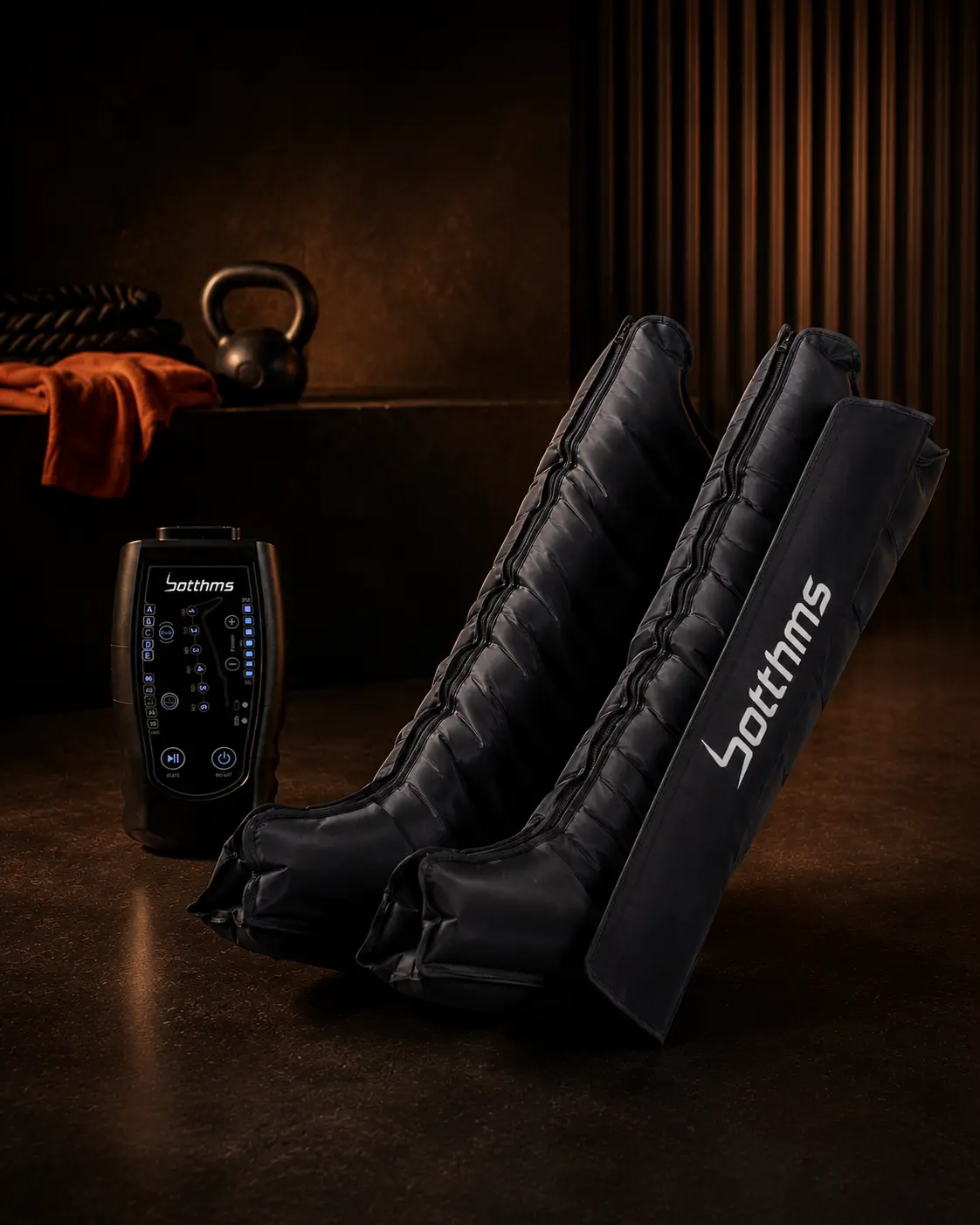
Short answer: yes — for what they’re realistically meant to do. Pneumatic compression boots reliably reduce perceived muscle soreness and fatigue and help you feel fresher for your next session. What they don’t do is magically rebuild muscle or replace training. Used as a recovery aid between hard efforts, they earn their place. Here’s the honest breakdown.
What are compression boots?
They’re sleeves that wrap your legs (sometimes arms or hips) and inflate in timed, sequential chambers — squeezing from the foot upward, then releasing. The idea is to mechanically assist your circulatory and lymphatic systems in clearing the by-products of hard training, the same job your body does on its own, just nudged along.
You may know them by brand names like NormaTec. The underlying tool is intermittent (sequential) pneumatic compression — a technology borrowed from clinical medicine, where it’s long been used to manage swelling and circulation.
So do they actually work?
For the things athletes care about most day to day, the evidence is supportive: compression after hard training consistently lowers DOMS and the feeling of heavy, trashed legs; athletes report feeling readier for the next session, which matters because perceived readiness influences how well you actually train; and local circulation and waste clearance improve during the session itself.
Where the evidence is weaker — and where honest operators should say so — effects on hard performance markers like next-day power output or sprint times are mixed and often small. They are a recovery aid, not a training stimulus. They help you absorb training; they don’t replace it.
The fair conclusion: compression boots are one of the better-tolerated, lowest-risk, genuinely-felt recovery tools available — strongest for soreness and the subjective sense of recovery, modest for raw performance numbers.
Compression boots vs a foam roller — which is better?
They overlap but aren’t the same. A foam roller applies firm, targeted pressure you control — good for specific tight spots, cheap, and portable. Compression boots apply rhythmic, whole-limb, hands-off pressure for 20–30 minutes — better for global “flush the whole leg” recovery, and you can lie back and do nothing, which means people actually use them consistently.
The honest edge for boots is passivity and coverage: the best recovery tool is the one you’ll use, and it’s far easier to relax in boots for 30 minutes than to foam-roll diligently every day.
When should you use them?
- —After your hardest sessions — long runs, leg day, match day, doubles.
- —Between two efforts in a short window — the gap between a morning and afternoon session, or back-to-back competition days.
- —On heavy travel days — sitting for hours leaves legs sluggish; a session afterward helps.
A 30-minute session is the standard dose. Unlike cold, compression doesn’t blunt adaptation, so you can use it freely right after training.
How to use it at Botthms
Boots are the opening move in several of our protocols because they’re gentle and pair with everything. Flush is boots then sauna, the simple post-session leg-clear-and-warm. Renew is boots, ice, then sauna — the full post-training cascade. Prime is boots, red light, then sauna — training-safe and energising.
Book a recovery boots session in Randburg. 30 minutes, walk-in or member.
Frequently asked
Do compression boots really reduce soreness? Yes — reducing muscle soreness and the feeling of heavy legs is the effect they’re best supported for. Their impact on raw next-day performance is smaller and more variable.
How long is a session? 30 minutes is the standard, effective dose.
Are they better than a foam roller? For whole-leg, hands-off recovery, yes — and crucially, they’re easier to do consistently. A foam roller is better for targeting one specific tight spot.
Can I use them every day? Yes. They don’t interfere with training adaptation, so daily use is fine, especially in heavy training or competition blocks.
Who shouldn’t use compression boots? If you have a history of blood clots (DVT), severe peripheral vascular disease, or an acute leg injury, check with a doctor or our physio first.
Written by Renaldo Bothma — former professional rugby player and co-founder of Botthms.
Try it at the hub
Recovery Boots
Accelerate what your body already knows how to do.