2 Jun 2026 · 6 min read
Infrared Sauna Benefits: What the Evidence Says
One of the better-studied wellness habits there is — and unlike cold, heat doesn’t appear to blunt training adaptation.
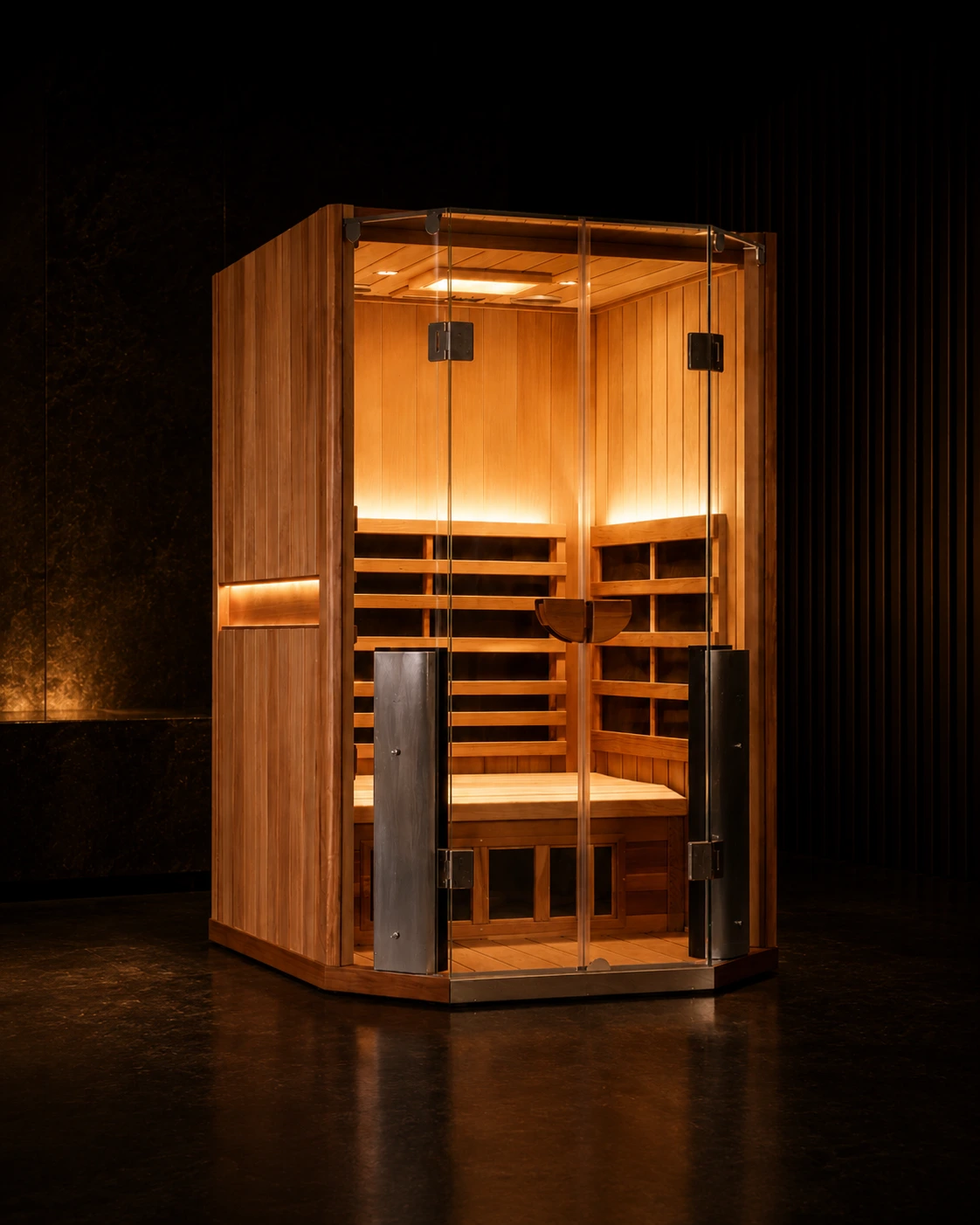
Short answer: regular heat exposure is one of the better-studied wellness habits there is — linked to improved cardiovascular markers, better sleep, and a recovery effect that, unlike cold, doesn’t appear to blunt training adaptations. The honest caveat: most of the strongest long-term data comes from traditional Finnish saunas, and infrared sauna research, while promising, is younger and smaller. Here’s the real picture.
What does an infrared sauna actually do?
A traditional sauna heats the air around you; an infrared sauna uses infrared light to warm your body more directly, which means it delivers a meaningful heat load at a more tolerable air temperature (typically 40–60°C rather than 80–100°C). The physiological signal — a rise in core temperature, increased heart rate, vasodilation, and sweating — is broadly similar: your body responds to heat as a mild, trainable stressor.
That heat stress drives adaptations: improved blood-vessel function, a heat-shock-protein response that supports cellular repair, and a parasympathetic rest rebound afterwards that many people feel as deep calm.
What are the benefits of an infrared sauna?
- —Cardiovascular conditioning. Heat raises heart rate and improves arterial flexibility in a way that mimics light aerobic exercise.
- —Recovery without blunting gains. Heat appears to support recovery and may even aid muscle adaptation — the opposite of the trade-off you face with post-workout ice.
- —Sleep quality. A heat session in the evening, followed by the natural core-temperature drop afterwards, can help you fall asleep faster.
- —Stress and HRV. The post-session parasympathetic rebound supports heart-rate-variability recovery and a genuine sense of decompression.
What about the famous “sauna makes you live longer” data?
You’ve probably seen the headline. It comes from the Finnish Kuopio cohort: men who used a sauna 4–7 times a week had markedly lower rates of sudden cardiac death and cardiovascular mortality than once-a-week users, in a dose-dependent pattern, over roughly two decades of follow-up (Laukkanen T. et al., 2015, JAMA Internal Medicine).
Here’s where we’ll be straight with you, because it matters: that study used traditional dry Finnish saunas, not infrared. It’s an observational cohort, so it shows association, not proof of cause. We think it’s a fair reason to be optimistic about heat therapy in general — but anyone claiming infrared specifically will add years to your life is reading more into the data than it supports. Infrared’s own evidence base is growing and encouraging, but it’s earlier-stage. We’d rather tell you that than oversell it.
Infrared sauna vs traditional sauna — which is better?
Neither is better outright; they’re different tools. A traditional sauna gives hotter air, the deepest long-term evidence base, and the classic intense heat experience. An infrared sauna gives gentler air temperature for the same heat load, often more comfortable for longer sessions and for people who find traditional saunas overwhelming.
For recovery and consistency — which is what actually drives results — the more comfortable, more repeatable option usually wins, and that’s often infrared.
How often should you use an infrared sauna?
Consistency beats intensity. 2–4 sessions a week of 20–40 minutes is a sensible, evidence-aligned target for most people. Hydrate before and after; the sweat load is real.
How to use it at Botthms
Heat sequences well with light and cold. Our Flush protocol (boots then sauna) is the simple way to clear the legs and finish warm after a hard session, and Contrast (sauna and ice together) uses heat and cold to reset the nervous system.
Book an infrared sauna in Randburg. Full-spectrum infrared, 40–60°C, walk-in or member.
Frequently asked
Is an infrared sauna as good as a traditional sauna? For recovery and comfort, often yes — it delivers a similar heat load at a lower air temperature. The deepest long-term mortality data is from traditional saunas, but the underlying heat-therapy mechanism is shared.
How hot is an infrared sauna? At Botthms, 40–60°C. That’s cooler air than a traditional sauna because infrared warms your body more directly.
Does a sauna help muscle recovery? Yes — and unlike a post-workout ice bath, heat doesn’t appear to blunt strength or muscle adaptations, which makes it a safer choice in the window right after training.
How long should I stay in? 20–40 minutes for most people. Come out if you feel light-headed, and rehydrate.
Can I use the sauna every day? Many people do, but 2–4 quality sessions a week captures most of the benefit. Listen to hydration and sleep.
Written by the Botthms team. Reviewed for accuracy against the cited literature.
References: Laukkanen T, et al. Association between sauna bathing and fatal cardiovascular and all-cause mortality events. JAMA Intern Med. 2015.
Try it at the hub
Infrared Sauna
Heat stress that builds instead of breaks.