2 Jun 2026 · 5 min read
Red Light Therapy Benefits for Muscle Recovery
One of the few recovery tools you can use freely right after a hard session — because, unlike ice, it doesn’t seem to blunt the gains you train for.
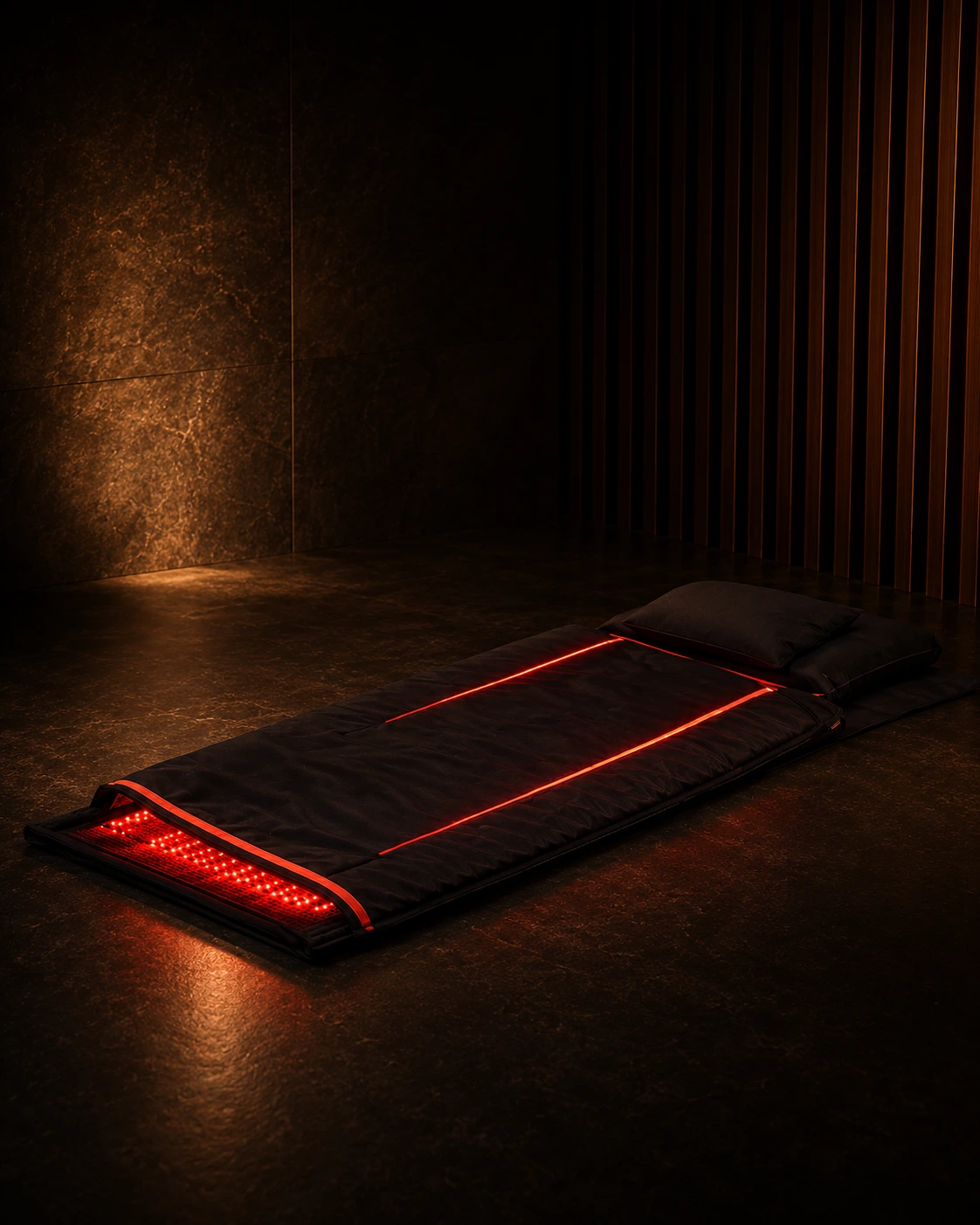
Short answer: red light therapy uses specific wavelengths of red and near-infrared light to support cellular energy production, which appears to reduce muscle soreness and aid recovery. Its standout advantage for athletes: unlike a post-workout ice bath, light therapy does not seem to blunt the muscle and strength adaptations you train for. That makes it one of the few recovery tools you can use freely right after a hard session.
What is red light therapy?
Also called photobiomodulation (PBM) or low-level light therapy, it exposes your body to controlled doses of light in two key bands: red light (~660 nm), absorbed more at the skin surface, and near-infrared (~850 nm), which penetrates deeper into muscle and joint tissue.
At Botthms it’s a full-body red and near-infrared LED session. The leading mechanism: these wavelengths are absorbed by mitochondria — your cells’ power plants — and appear to support more efficient energy (ATP) production and reduce oxidative stress, which downstream supports tissue repair.
What are the benefits of red light therapy?
- —Reduced muscle soreness and faster recovery. PBM applied around training has been associated with lower DOMS and quicker recovery of muscle function.
- —It doesn’t blunt training adaptations. This is the key differentiator. Where post-exercise cold can attenuate strength and muscle gains (Roberts et al., 2015, J Physiol), light therapy doesn’t carry that trade-off — so it’s a safe choice in the window straight after lifting.
- —Skin and tissue support. Red wavelengths are studied for skin quality and superficial tissue repair.
- —A gentle, passive session with no heat or cold stress — easy to stack onto anything.
As always, the honest framing: the evidence for recovery and soreness is encouraging and growing, dosing (wavelength, intensity, distance, time) genuinely matters, and PBM is a support tool, not a replacement for sleep and sound training.
Why “doesn’t blunt adaptations” matters so much
Here’s the recovery dilemma in one line: the things that reduce soreness fastest (like cold) can also reduce the training signal you wanted. Red light is interesting precisely because it appears to sidestep that trade-off — soreness relief and recovery support without telling your muscles to stop adapting.
- —Building strength or muscle? Red light is one of the few tools you can use immediately post-session without second-guessing it.
- —Want soreness relief but it’s a growth block? Reach for light, not ice, in the anabolic window.
How often should you use it?
PBM rewards consistency — several sessions a week tends to beat the occasional one-off, because the cellular effects accumulate. A standard session is short and entirely passive: you simply expose the target areas to the light for the set time.
How to use it at Botthms
Red light is the priming step in two of our protocols. Plunge and Glow runs red light then ice, to prime the tissue, then a short cold plunge for alertness without blunting adaptation. Recharge runs red light, sauna, then ice — the morning-before-competition primer, engineered to prepare rather than deplete.
Book red light therapy in Randburg. Full-body 660 nm + 850 nm, walk-in or member.
Frequently asked
What does red light therapy do? It delivers red and near-infrared light that your mitochondria absorb, supporting cellular energy production and tissue repair — which is associated with less soreness and faster recovery.
Does red light therapy blunt muscle gains like ice baths can? No — that’s its key advantage. Light therapy supports recovery without the adaptation trade-off that post-workout cold immersion can carry, so it’s safe right after training.
What’s the difference between 660 nm and 850 nm? 660 nm (red) acts more at the skin surface; 850 nm (near-infrared) penetrates deeper into muscle and joints. Full-spectrum sessions use both.
How often should I do red light therapy? Several short sessions a week, since the cellular effects build with consistency.
Is it safe? Do I need eye protection? It’s non-thermal and well tolerated. We guide positioning and eye protection where appropriate.
Written by the Botthms team.
References: Roberts LA, et al. J Physiol. 2015 (on cold-immersion blunting adaptation, for contrast).
Try it at the hub
Red Light Therapy
Recovery that doesn't cost you gains.